You can sell a fire-damaged house in California without repairing it. Compare repairing with insurance money, selling as-is for cash, and selling with the claim open.
In this post
- Start With Your Policy, Not Your Contractor
- Why Smoke Costs More Than Fire
- Your Three Options, Side by Side
- Who Actually Controls the Insurance Check
- What You Have to Disclose About a Fire in California
- What a Cash Offer on a Fire Damaged House Is Built From
- The Southern California Wrinkle
- How We Handle a Fire Damaged House
- Conclusion
- About the Author
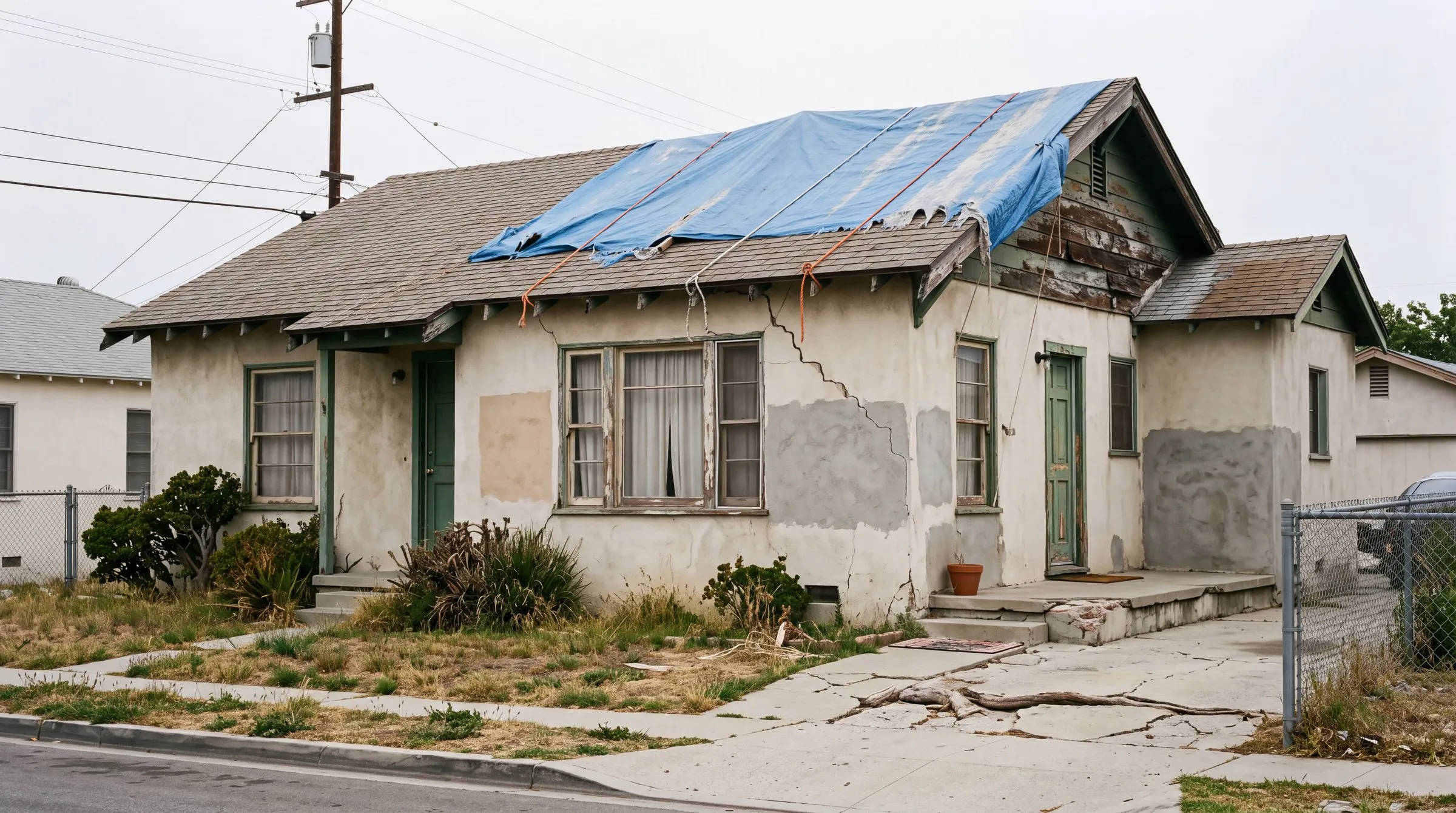
Yes. You can sell a fire damaged house in California, and you do not have to repair it first. You have three real paths: repair it with insurance money and list it, sell it as is for cash, or sell it with the claim still open. Which one pays you most depends on your policy, not your house.
Summary
- No California law forces you to repair fire damage before you sell. Repair is a choice, not a requirement.
- Your insurance policy drives this decision more than the damage does. Replacement cost and actual cash value pay very differently.
- If you still have a mortgage, your lender is almost always named on the claim check and controls when the money is released.
- Smoke and water from the fire hoses are often more expensive than the burned part.
- You must disclose the fire. A fire is a material fact about the property, whether or not it was repaired.
- A fire damaged house can still be financed by some buyers, which means a listed sale is not automatically off the table.
Start With Your Policy, Not Your Contractor
Most people call a contractor first. That is backwards. The contractor tells you what repairs cost. Your policy tells you how much of that you will actually be handed. Those two numbers can be very far apart.
Two words decide most of it.
Replacement cost value. The policy pays what it costs to rebuild today, up to your limits. You usually get paid in two pieces. The first check is the depreciated amount. The rest, called recoverable depreciation, is released only after you actually do the work and show receipts.
Actual cash value. The policy pays what the damaged property was worth the day it burned, after depreciation. There is no second check. A twenty year old roof is paid as a twenty year old roof.
That difference changes the whole decision. On a replacement cost policy, walking away without rebuilding can leave real money on the table, because the recoverable depreciation is only released if you rebuild. On an actual cash value policy, the money is the money. Rebuilding does not unlock more.
So before you price repairs, get three things in writing from your carrier or your public adjuster:
- Whether your dwelling coverage is replacement cost or actual cash value.
- Your dwelling limit, and whether you have extended or guaranteed replacement cost on top of it.
- What has already been paid, what is being held back, and what condition releases the holdback.
The California Department of Insurance publishes consumer guidance on residential claims and on what carriers owe policyholders after a loss. Read it before you sign anything, including any repair contract.
Why Smoke Costs More Than Fire
Sellers look at the black part and assume that is the damage. Buyers and contractors look at everything the smoke touched, which is usually the entire house.
Here is what tends to drive the real number:
- Smoke and soot. Soot is acidic and it travels. It gets into drywall, insulation, ductwork, cabinets, wiring and framing far from the burn. Sealing and deodorizing a whole house is a large line item on its own.
- Water. The fire department puts a lot of water into the structure in a short time. That water sits in walls and under floors. Left alone, it becomes the problem covered in our guide to selling a house with water damage.
- Electrical and HVAC. Heat degrades wiring insulation and melts duct board. Inspectors often require full replacement of affected runs rather than patching.
- Code upgrades. When you open walls on an older Southern California house, current code comes with it. That can mean new electrical, new plumbing, sometimes seismic work the original house never had.
This is why a seller who priced repairs from the visible damage is usually shocked by the first real bid. The visible damage was the cheap part.
Your Three Options, Side by Side
There is no universally right answer here. There is a right answer for your policy, your timeline and your tolerance for managing a construction project.
| Repair, then list | Sell as is for cash | Sell with the claim open | |
|---|---|---|---|
| Who pays for the work | You, from claim money, up front | Nobody. The buyer takes it as is | Nobody before closing |
| Your time to cash | Rebuild time plus listing time | Days to weeks | Days to weeks |
| Top line price | Highest | Lower | Lower, adjusted for the claim |
| What you net | Price minus repairs, carrying costs, commissions | Price, with no repairs or commissions | Price plus whatever claim proceeds you keep |
| Who manages contractors | You | Nobody on your side | Nobody on your side |
| Main risk | Bids run over. Holdback is not released | Fewer buyers, so pick a real one | Claim assignment terms must be clear in writing |
| Best when | Policy is replacement cost and you can run a job | You want out, or the rebuild is larger than the equity | The claim is large and still being adjusted |
One honest note on the first column. Repair and list produces the highest sticker price almost every time. It does not always produce the highest number in your pocket, because the sticker price has to carry the rebuild, the months of mortgage and insurance while you rebuild, and the cost of selling. Run that math before you assume listing wins. Our guide on whether to renovate before selling walks through the same arithmetic for a house that is not fire damaged.
Who Actually Controls the Insurance Check
This is the part that surprises sellers most, and it is the part that stalls the most deals.
If you have a mortgage, your lender has an interest in the property, and your claim check is normally made out to you and the lender together. The lender endorses it into a restricted account and releases funds in stages as the repair work is inspected and completed. That is standard practice, not your carrier being difficult.
What that means in practice:
- You usually cannot simply cash the check and sell the house in its damaged condition without talking to your servicer.
- If the loan is paid off at closing, the lender’s interest in the claim proceeds generally resolves at the same time, but the sequencing has to be handled deliberately by escrow.
- If you intend to keep any part of the claim after selling, that has to be written into the purchase agreement. It does not happen by default.
Before you accept any offer on a fire damaged house, ask the buyer one question: who is keeping the insurance proceeds, and where does the contract say so? If the answer is vague, the answer is no.
What You Have to Disclose About a Fire in California
A fire is a material fact. It affects both the value and the desirability of the property, which is the test California uses. You disclose it.
For most sales of one to four residential units, California requires the seller to deliver a Real Estate Transfer Disclosure Statement. The requirement sits in the Civil Code beginning at section 1102. Some transfers are exempt, including certain foreclosure and court ordered transfers, but the general duty to avoid fraud, misrepresentation and deceit does not go away with the form.
Practical points sellers get wrong:
- Repaired does not mean undisclosed. A fire that was fully repaired and permitted is still a fire that happened. Disclose it and attach the permits and the completion documents. Those documents help you.
- Unpermitted repair is worse than no repair. If someone patched the house without pulling permits, say so. Buyers find this at inspection, and finding it after the fact is how lawsuits start.
- You cannot answer a direct question falsely. Even where a disclosure might otherwise be excused, misrepresenting the answer to a direct question is a separate problem.
- Timing matters. If the disclosure reaches the buyer after the purchase agreement is signed, the buyer gets a termination right. California gives three days after delivery in person and five days after delivery by mail.
Selling a house as is does not switch the disclosure duty off. As is addresses who pays for repairs. It does not address what you knew and did not say. We cover that distinction in depth in our general guide to selling a house as is in California.
Nothing here is legal advice. Disclosure questions on a fire damaged property are worth twenty minutes with a California real estate attorney.
What a Cash Offer on a Fire Damaged House Is Built From
Sellers ask how buyers like me arrive at a number. On a fire damaged house, the offer is what the house sells for once fully rebuilt and finished, minus the full rebuild cost, the months of carrying cost while permits move, the cost to resell it and the buyer’s margin. When the rebuild is large, that number can be well under what the lot plus a finished house would suggest, and that is not a trick. It is the rebuild being genuinely expensive.
Two things you should insist on from any buyer:
- Show you the rebuild number they used. If they will not, they are guessing or they are planning to renegotiate later.
- Tell you plainly who is funding it. On our side, the purchase and the rebuild are funded up front by me and my capital partner, and my project manager runs the work. That is why we do not need to come back and reprice after you are already committed.
If you want the full breakdown of how these numbers get built, read how much cash buyers actually pay for houses.
The Southern California Wrinkle
Three local realities change this calculation here in a way they would not in most of the country.
Insurance availability. Fire insurance in parts of Southern California has become hard to place. Some buyers who would otherwise finance a purchase cannot get a policy at a workable price, which shrinks your buyer pool for reasons that have nothing to do with your house. The California FAIR Plan exists as the insurer of last resort for basic fire coverage when the standard market will not write the risk.
Rebuild cost versus value. On a lot where the finished house is worth a great deal, a full rebuild can still pencil. On a lot where it is not, the rebuild can approach or exceed what the finished house would sell for. That is the point at which almost every seller is better off selling the property rather than financing a rebuild out of pocket.
Permitting time. Plan check and permitting in Los Angeles County and the surrounding cities is not quick, and a substantial rebuild is not a quick permit. Every month in that queue is a month you are carrying the property.
Speculation, flagged as such: if insurance availability in high risk Southern California zip codes keeps tightening, I expect the spread between a repaired house and a fire damaged house to widen further, because the buyer pool for the damaged one narrows faster than the pool for the finished one. That is my read of the direction, not a measured figure.
How We Handle a Fire Damaged House
I buy houses in Southern California for my own account, including houses that have burned. Here is what that looks like, so you can compare it against anything else you are considering.
- I look at the property in its current condition. You do not clean it, clear it or repair anything.
- I give you the rebuild number I am working from, so you can see how the offer was built.
- The purchase and the rebuild are funded up front by me and my capital partner. My project manager runs the work after closing.
- You pick the closing date. If you need time to finish an insurance claim or find your next place, we work around it.
- If listing with an agent would clearly net you more, I will tell you that, and I will show you the math I used.
I am not going to promise you an outcome I do not control, and I am not going to tell you a cash sale beats a listing in every situation. It does not. It wins when the rebuild is large, when the timeline matters, or when you simply do not want to run a construction project from a distance.
If you want a straight number on your property, you can reach us through our page on selling a fire damaged house in Los Angeles. No cost, no obligation, and no pressure to take it.
Conclusion
A fire damaged house is sellable. The question is never whether you can sell it. The question is which path leaves the most money in your hands after everything is paid.
Work in this order. Pull your policy and find out whether it is replacement cost or actual cash value. Call your servicer and find out who controls the check. Get one honest rebuild number. Then compare repair and list against a cash sale using the net figure, not the sticker price.
Most sellers who do this in that order make a decision they are comfortable with inside a week. The ones who get stuck are the ones who started with a contractor bid and never looked at the policy.
About the Author
Rapid Close SoCal, LLC buys houses as an investor, for its own account, for profit and resale. It is not a licensed real estate brokerage and is not your agent. Listing and agency services are provided separately by Jose Schnaider, licensed California real estate salesperson, DRE number 01975968, under Dream Team Real Estate Consultants Inc, and only under a signed listing agreement. Nothing here is legal, tax or financial advice. Talk to your own attorney or CPA, and I will work with whatever they advise.
Sources
- California Department of Insurance. (n.d.). Residential property insurance and claims information.
- California Department of Real Estate. (n.d.). Disclosures in real property transactions (RE 6).
- California FAIR Plan Association. (n.d.). About the FAIR Plan.
- Greene, D. M. (2019). Buy, rehab, rent, refinance, repeat: The BRRRR rental property investment strategy made simple. BiggerPockets Publishing.
- Stone, M. (2019). Real estate investing for everyone: A guide to creating financial freedom. Ixia Press.
- Turner, B. (2020). The book on investing in real estate with no (and low) money down (Rev. ed.). BiggerPockets Publishing.
Common questions
Can you sell a fire damaged house?
Yes. No California law requires you to repair fire damage before selling. You can list it as is, sell it to a cash buyer, or rebuild first and then sell. You do have to disclose the fire and the damage to any buyer.
Should I take the insurance payout or sell my fire damaged house as is?
It depends on your policy type. On a replacement cost policy, part of the payout is released only if you actually rebuild, so walking away can forfeit it. On an actual cash value policy, rebuilding unlocks nothing extra. Check which you have before deciding.
Do I have to disclose a house fire when I sell in California?
Yes. A fire is a material fact affecting value and desirability, so it belongs on your disclosures even if the repairs were completed and permitted. Attach the permits and completion records. Unpermitted repair work must be disclosed too.
Who buys fire damaged houses?
Mostly cash buyers and builders who can fund a rebuild without a conventional loan. Some retail buyers can use renovation financing. Your buyer pool is smaller than normal, so verify that whoever you pick can actually close.
Can I sell my house while the insurance claim is still open?
Often yes, but the purchase agreement must state who keeps the claim proceeds, and your mortgage servicer usually has to sign off because the lender is named on the check. Handle this in writing before you accept an offer.